
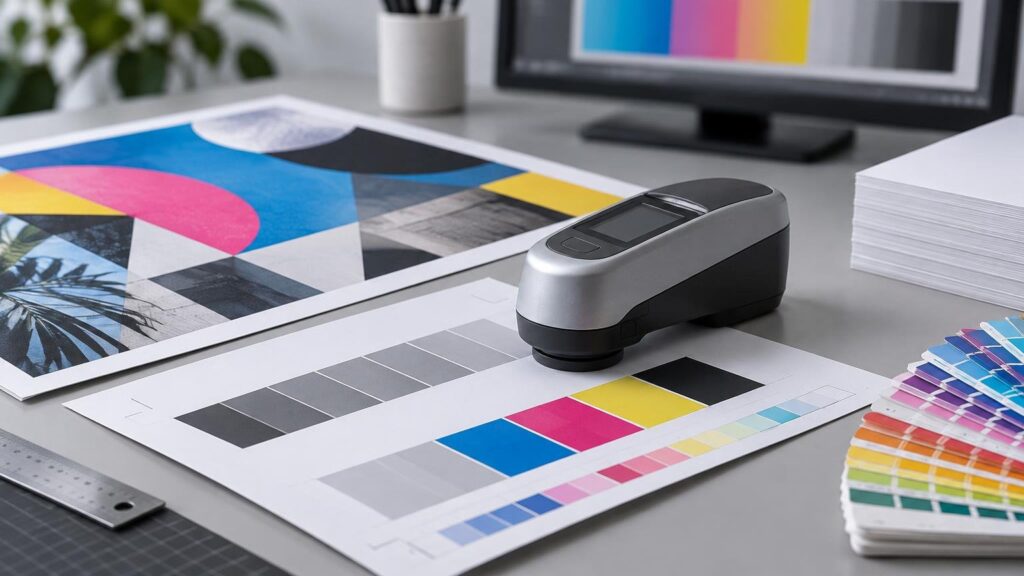
TLDR: The difference between G7 and GRACoL is their job in the production workflow. G7 is a calibration methodology used to control neutral gray balance and tonal response. GRACoL is a defined reference print condition associated with commercial sheet-fed offset printing. They are complementary, not competing choices: a printing system can use G7 methods while working toward an appropriate GRACoL condition, but neither term alone guarantees an exact color match.
The practical distinction matters because “We print to G7” and “We target GRACoL” answer different questions. The first describes how output behavior is calibrated and maintained. The second identifies the reference appearance, characterization data, or output condition against which color may be prepared and evaluated. PRINTING United Alliance makes this distinction in its print-production specifications resources, separating G7 calibration from the GRACoL commercial-print condition.
G7 vs. GRACoL at a glance
| Question | G7 | GRACoL |
|---|---|---|
| What is it? | A calibration methodology | A reference print condition and associated characterization resources |
| Primary purpose | Control neutral appearance and tonal response | Describe an intended commercial-print appearance |
| Main control point | Measured output, gray balance and tone reproduction | A named condition against which output or proofs can be evaluated |
| Typical production question | Is the device producing controlled, repeatable neutral tones? | What print condition are the file, proof and presswork intended to represent? |
| Who uses it? | Press operators, color technicians and production teams | Designers, prepress teams, proofing operators, printers and print buyers |
| Is it an ICC profile? | No | GRACoL characterization data can be used to build ICC profiles, but the condition and profile are not interchangeable terms |
| Does it apply universally? | No; calibration still must fit the process and production goal | No; a GRACoL condition is not automatically appropriate for every process, substrate or product |
Why CMYK numbers do not define appearance by themselves
A CMYK build is an instruction to a printing system, not a complete description of the color a viewer will see. The result also depends on ink or toner behavior, substrate color and surface, screening, tone reproduction, device condition, finishing and viewing light. The same nominal CMYK percentages can therefore produce visibly different reflected colors on two uncontrolled systems.
This is the production problem behind both G7 and GRACoL. G7 addresses how a device behaves, particularly through neutral gray balance and tonal response. GRACoL provides a defined reference condition that gives the workflow a more specific destination. Without control, neutrals may lean warm or cool, shadows may become too heavy, and repeat runs may move even though the source file has not changed.
Screen appearance adds another variable. Monitors emit light, while printed pieces reflect it. RGB artwork also has to be converted for CMYK production, and not every screen color is reproducible with a particular ink, toner, paper and press combination. A small screen-to-print shift is not automatically evidence of a production defect.
What G7 controls
G7 is best understood as a calibration and process-control approach. A production team prints a suitable target, measures the result, evaluates neutral and tonal behavior, and applies correction curves or other device adjustments. The adjusted system is then measured again to determine whether it is operating within the intended condition.
Two central concepts are gray balance and the Neutral Print Density Curve, usually shortened to NPDC. Gray balance concerns whether combinations intended to appear neutral actually look neutral. The NPDC describes tonal behavior from highlights through midtones and shadows. PRINTING United Alliance identifies both as important parts of G7 process control.
The buyer consequence is not simply “better color.” More precisely, calibration reduces avoidable variation in neutral appearance and tone reproduction. That can improve the relationship between separately controlled devices, make proofs more useful and help repeat production remain closer to expectations.
Calibration is not permanent. Consumables, environmental conditions, maintenance, substrate lots and device state can change output. PRINTING United Alliance notes that devices drift and that maintaining a G7 print condition requires continuing attention. A production claim is therefore more meaningful when it is supported by current measurement and verification rather than treated as a one-time setup event.
What GRACoL defines
GRACoL is associated with a reference print condition for commercial sheet-fed offset production. Its supporting resources include characterization data, profiles, test charts and control tools. These resources let different participants describe an intended output condition more precisely than a vague request for “standard CMYK.”
The version or full condition name matters. Saying only “GRACoL” can leave uncertainty about which dataset, profile or production expectation is intended. For example, the ICC Profile Registry lists GRACoL2013_CRPC6 in connection with the CGATS21-2-CRPC6 characterization reference. The registry lists 320% total area coverage for that named profile, but that value is an attribute of the particular registered profile—not a universal ink limit for every press, material or job.
GRACoL should not be treated as the required destination for all digital printing, wide-format output, uncoated work, specialty materials or card production. The appropriate condition depends on what the provider can reproduce consistently and how the product will be manufactured. A printer may use G7 calibration concepts while targeting a different documented output condition.
Calibration, characterization and ICC profiles are different layers
These terms often get compressed into one idea, but each performs a different function:
- Calibration adjusts a device so that its output follows a controlled behavior.
- Characterization records how a defined printing condition reproduces color.
- An ICC profile packages color-behavior information for use by a color-management system.
- A proof attempts to simulate an identified output condition under controlled production and viewing assumptions.
- Process control checks whether the printing system remains close enough to its intended behavior during production.
The International Color Consortium explains that ICC profiles provide information used to convert between device color spaces and device-independent color spaces. An ICC profile is therefore part of color-managed translation; it is not a substitute for maintaining the physical printing device.
Profile conversion also requires decisions when source colors fall outside the destination gamut. Rendering intents determine how those colors are handled, and the ICC notes that perceptual rendering can vary by vendor. Two workflows can use profiles bearing the same general condition name yet produce differences if their conversion settings, software or source files are not aligned.
What “G7 calibrated to GRACoL” means in practice
In practical language, this phrase usually indicates that G7 methods are being used to control the device’s neutral and tonal behavior while a specified GRACoL condition provides the intended reference for matching, proofing or evaluation. It does not mean G7 has become GRACoL, nor does it mean the press can reproduce every color contained in a source image.
A simplified workflow looks like this:
- Identify the intended output condition and the actual substrate and printing process.
- Print and measure a calibration target on the production system.
- Adjust curves or device controls to bring neutral balance and tone response into the intended range.
- Reprint and verify the adjusted result.
- Build or select the appropriate color-management path for the documented condition.
- Produce a contract or approval proof when the job’s color risk justifies one.
- Monitor production and recalibrate when measurements indicate drift.
The sequence matters. Assigning or converting to a GRACoL-related profile does not physically calibrate a press. Conversely, achieving G7 calibration does not by itself tell a designer which ICC profile, proof setup or output condition to use.
What designers and print buyers should specify
For designers
Do not automatically convert every CMYK file to a GRACoL profile. Ask the provider which output condition, profile policy and PDF settings apply to the actual product. This is especially important when the job uses an uncoated stock, synthetic material, laminate, specialty card stock or non-offset production process.
Also determine whether the printer wants files converted to a destination profile, left in a tagged source space, or supplied through another documented workflow. Preserve an untouched source file so that an inappropriate conversion does not become permanent.
For print buyers
Put the color expectation in the specification rather than relying on a G7 logo or a general request for GRACoL color. A useful specification identifies the product, stock, printing process, expected output condition, proof type, approval authority and tolerance or acceptance method. For a critical rerun, include the approved prior sample while recognizing that an aged sample may no longer represent its original appearance.
For production teams
Document the calibration state, measurement method, target condition and recalibration trigger. Keep proofing, plate or RIP curves, press controls and production verification conceptually separate. When a job changes stock or moves to another device, determine whether the existing condition still applies instead of assuming that the same CMYK values will carry over unchanged.
Why G7 and GRACoL do not guarantee an exact match
A controlled workflow narrows uncertainty; it does not remove physical limits. Paper white changes the lightest printable appearance. Surface texture and coating affect ink holdout, gloss and perceived saturation. Lamination or another finish can alter contrast and color appearance. Gamut limits constrain saturated colors, while viewing light changes what the observer sees.
The proof and finished piece may also use different imaging technologies and materials. A useful proof predicts the intended condition within documented limits; it is not necessarily made from the final stock or printing process. When color is commercially important, approve the correct type of proof and evaluate it under suitable viewing conditions rather than using an uncontrolled office monitor as the sole reference.
Common misconceptions
- “G7 is a CMYK profile.” It is a calibration methodology, not an ICC profile.
- “GRACoL calibrates the press.” GRACoL identifies a reference print condition; calibration is the work used to control device behavior.
- “A G7-calibrated printer must target GRACoL.” G7 methods can support other suitable print conditions.
- “GRACoL is correct for every CMYK product.” The correct condition depends on the process, substrate and provider workflow.
- “Matching profile names guarantee matching output.” Device maintenance, conversion settings, gamut, paper, finishing, proofing and viewing conditions still affect the result.
- “If it matches on screen, it will match in print.” An uncontrolled display cannot serve as a dependable prediction of reflected print color.
The practical takeaway
Do not ask whether G7 or GRACoL is better. Ask two separate questions: How is the production device calibrated and maintained, and what documented output condition is the job intended to match?
For routine work, follow the printer’s current file-preparation instructions and review the supplied proof carefully. For brand-sensitive color, neutral-heavy imagery, skin tones or repeat campaigns, request the precise output condition and an appropriate approved proof. That specification turns two easily confused industry terms into a workable production plan.