
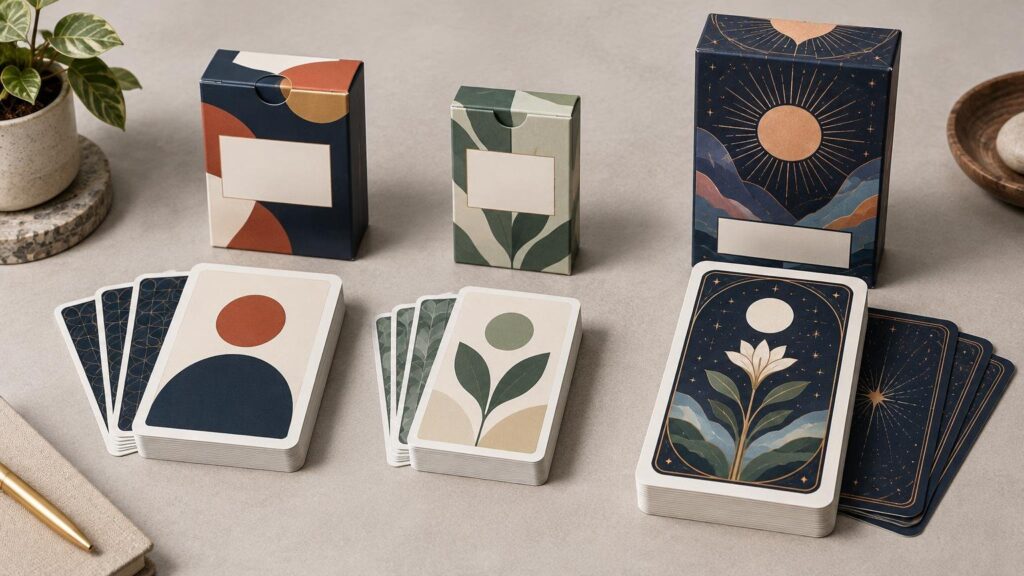
Poker, bridge, and tarot cards differ by fractions of an inch, but those fractions change how a deck feels, how much artwork it can carry, and what kind of box it needs. Poker size is the most versatile baseline. Bridge size is better when players must hold many cards at once. Tarot size gives illustration and text more room, with a corresponding increase in handling and packaging demands.
TLDR: Choose around the hand, artwork, and box
- Choose poker size, 2.5 × 3.5 inches, for a familiar playing-card or trading-card format with balanced handling and artwork space.
- Choose bridge size, 2.25 × 3.5 inches, when players will hold large hands or when a narrower deck better suits the game.
- Choose the common 2.75 × 4.75-inch tarot format for image-led cards, titles, symbols, or interpretive content that needs more room.
- Do not estimate the box from face dimensions alone. Card count, stock caliper, coatings, inserts, and packing determine the required depth.
- Build artwork from the printer’s template rather than multiplying finished dimensions by resolution. Bleed, trim, and safe-area requirements add production space around the finished card.
Poker vs bridge vs tarot dimensions
Printiverse’s current card-image guidance identifies finished dimensions of 2.5 × 3.5 inches for poker cards, 2.25 × 3.5 inches for bridge cards, and 2.75 × 4.75 inches for tarot cards. These are useful production baselines, although tarot decks in particular are also sold in other formats.
| Format | Finished size | Face area | What the proportion favors |
|---|---|---|---|
| Bridge | 2.25 × 3.5 in | 7.875 sq in | Large hands, narrow layouts, compact horizontal footprint |
| Poker | 2.5 × 3.5 in | 8.75 sq in | General play, trading-card proportions, balanced layouts |
| Tarot | 2.75 × 4.75 in | 13.0625 sq in | Vertical illustration, titles, symbols, and supporting text |
Poker and bridge cards have the same height, but bridge cards are 0.25 inch narrower—a 10% reduction in width. Poker therefore supplies about 11.1% more face area than bridge. The common tarot format has about 49.3% more face area than poker. Those percentages describe the full trimmed face, not the unrestricted design area; trim tolerance and safe margins still reduce where critical content should sit.
Handling is about width as much as total size
Bridge cards exist for a practical reason: a narrower card makes a wide hand easier to hold and fan. The U.S. Bridge Federation’s discussion of card sizes notes that bridge and poker cards can be used across games, while associating the narrower bridge format with holding larger hands. Format names describe conventions, not hard restrictions.
Poker size is a sensible default when a deck has ordinary hand sizes, frequent shuffling, or an audience already comfortable with standard playing and trading cards. Its extra quarter-inch of width also gives pips, labels, illustrations, or side-by-side interface elements more breathing room. The wider proportion is commonly associated with card manipulation and cardistry as well.
Tarot cards make a different compromise. The taller, wider face improves visibility and creates a more substantial object, but it also asks more of the user’s hands. Fanning, overhand shuffling, table space, sleeves, and storage all become more consequential. A project can use custom tarot cards without following one mandatory tarot dimension; for example, U.S. Games lists a pocket tarot deck at 2.5 × 3.75 inches.
Artwork space changes the layout, not just its scale
Moving a poker design onto bridge size is not a simple proportional reduction because the height stays fixed while the width contracts. A centered portrait may transfer cleanly, but wide illustrations, long titles, horizontal status bars, and corner information can become crowded. Reflow the composition instead of squeezing it.
Poker size provides a useful middle ground. It accommodates conventional indices and suit marks, game text, character art, or branded backs without becoming unusually large in the hand. Designers working toward this format can review the current poker-card printing path after settling the deck structure and artwork approach.
Tarot’s additional area is most valuable when the content actually uses it. A tall image can establish hierarchy among the illustration, card name, symbols, keywords, and border treatment. Simply enlarging poker-size artwork may produce oversized type, empty space, or details that still fail to read clearly. The current Rider-Waite-Smith deck specifications from U.S. Games provide one real-world example of the 2.75 × 4.75-inch format and a 78-card deck.
Thin borders make production variation more visible
All three formats need bleed beyond the trim and a protected safe area inside it. Cutting occurs to a tolerance rather than on a mathematically perfect line, so important text, symbols, and faces should remain away from the edge. Artwork intended to reach the edge should extend fully through the bleed area.
Thin, symmetrical borders are especially demanding. A small shift can make one side look visibly heavier even when the card remains within normal production tolerance. Full-bleed backgrounds, wider borders, or deliberately irregular frames usually make minor alignment variation less conspicuous.
Printiverse currently lists minimum image-upload dimensions at 300 DPI of 822 × 1,122 pixels for poker, 747 × 1,122 pixels for bridge, and 897 × 1,497 pixels for tarot. These are production-upload specifications, not direct finished-size conversions, because the files account for the printer’s required working area. Use the current template rather than rebuilding those dimensions from memory.
Card size does not determine deck thickness
A tarot card has a larger footprint than a poker card, but face dimensions alone do not reveal how thick the completed deck will be. Stack depth depends on the number of cards, individual-card caliper, coatings or laminates, inserts, and how tightly the contents are packed. Stock names or weight descriptions should not be treated as box-depth measurements.
Card count can create a major difference. A standard playing deck contains 52 cards, while a typical retail pack may add jokers or other extras. The cited Rider-Waite-Smith tarot deck contains 78 cards. Compared with a 54-card pack, 78 cards represents about 44.4% more cards before any stock or coating differences are considered. Saskatchewan’s official playing-card standard describes the standard 52-card deck, while the tarot count comes from the manufacturer’s product specification.
That is why packaging should be engineered around an assembled deck specification, not ordered from a generic size label. The internal length and width must allow the cards to enter without edge damage, while the depth must accommodate the complete stack and any booklet, divider, tray, or insert. Different retail packages can surround cards of the same face size, so an outside box dimension is not a universal template.
Which format fits each project?
Use poker size as the general-purpose default
Poker size fits conventional playing decks, many game systems, promotional decks, and trading-card-style projects. Choose it when broad familiarity, balanced handling, and access to standard-size accessories matter more than maximizing the number of cards held in one hand.
Use bridge size for hand-heavy play
Bridge size is the stronger choice when players routinely fan a large number of cards. It can also suit compact travel games, provided the narrower artwork area does not force text or icons into an uncomfortable layout. Printiverse currently maintains a separate bridge-card printing option, so the format can be treated as its own production layout rather than a cropped poker file.
Use tarot size when the image leads
The larger tarot canvas suits oracle decks, image-led games, teaching cards, prompts, and projects where the card itself should feel substantial. The tradeoff is a bigger hand span, more table area, larger sleeves, and packaging designed for both the footprint and the complete stack.
Preflight the format before designing the whole deck
- Choose the finished format from game mechanics and typical hand size.
- Confirm the current printer template, bleed, safe area, resolution, stock, finish, and packaging options.
- Build one representative card containing the longest title, densest text, smallest symbols, and most demanding border.
- Print that card at actual size on an office printer to assess handling and readability, while recognizing that it will not reproduce the final stock, finish, or color.
- Review the digital proof for artwork, text, placement, sizing, orientation, and trim guidance.
- If physical feel, actual-size readability, finish, or material is a deciding factor, ask whether a sample pack or paid physical proof is available for the order.
A digital proof is valuable for checking content and geometry, but it does not guarantee an exact screen-to-print match for color, texture, finish, or physical feel. Printiverse says physical proofs may be available for supported orders for a fee, while sample packs can help with material and handling decisions.
The practical choice
Start with poker size unless the project gives you a reason to move. Shift to bridge when holding a large hand matters more than horizontal design space. Move to tarot when the larger visual field improves the purpose of each card enough to justify the handling and packaging consequences.
Before producing the full deck, lock the finished dimensions, card count, stock, finish, and box contents. Then place the most difficult card into the current production template and evaluate it at actual size. That single preflight step will reveal more than choosing a format by name alone.
References
- Printiverse – Custom Print Products | Stickers, Invitations & Cards
- Card Image Guidelines – Printiverse
- U.S. Games Systems, Inc. > Tarot > Reflective Tarot Featuring the Radiant Rider-Waite® Tarot (Pocket Size)
- Continued from page 11)
- Trading Card Sizes and Specs: Standard, Oversized, and Custom – Printiverse
- U.S. Games Systems, Inc. > Tarot & Inspiration > Rider-Waite-Smith® Tarot Deck
- Print Tarot Cards – Printiverse
- PLAYING CARDS
- U.S. Games Systems, Inc. > Tarot & Inspiration > The Field Tarot
- Proofing & Approval Process – Printiverse
- Samples And Physical Proofs – Printiverse