
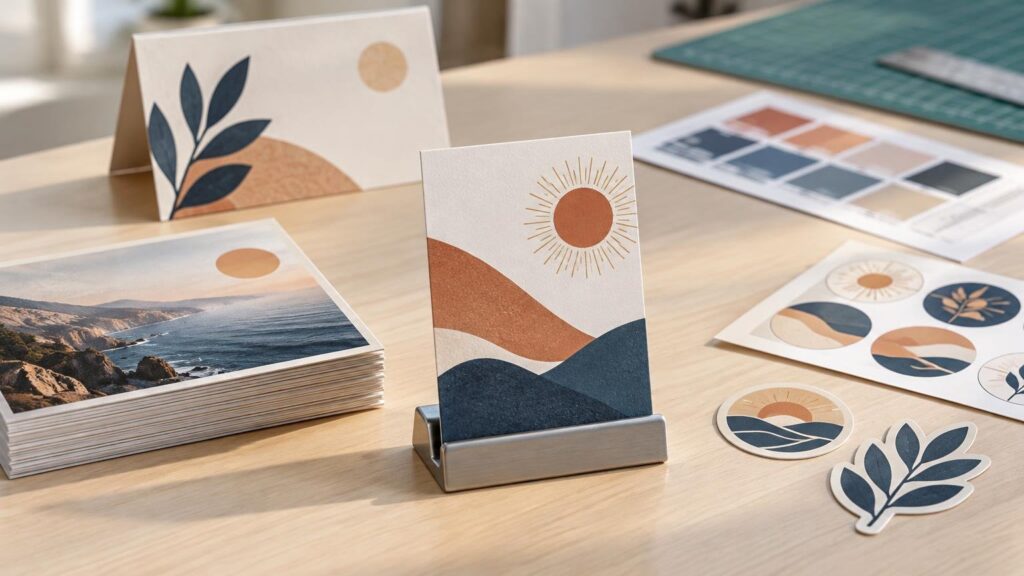
TLDR: Give every printed piece one job
Business cards fit into a small-business launch kit as person-to-person contact and follow-up tools. They work best when the owner, sales team or staff regularly meets prospects in person. They do not replace a website, sales sheet, postcard, package label or operational paperwork. Build the kit around actual customer interactions: cards for conversations, postcards or flyers for local reach, and stickers or labels for products and packaging.
The right launch kit is usually smaller than a new owner expects. Start with pieces tied to a known sales channel, order enough to learn from real use, and postpone decorative extras until they have a defined purpose. The broader small-business launch checklist can help sequence print alongside the logo and website.
Start with the sales path, not a shopping list
A launch kit should support the way a customer discovers the business, evaluates it and takes the next step. The U.S. Small Business Administration’s marketing guidance connects marketing activity to a target market, competitive advantage, sales methods, channels, goals and budget. It also recommends comparing marketing costs with revenue and adjusting the plan based on results.
That framework produces better print decisions than ordering a matching set simply because it looks complete. A consultant who wins work through networking may need excellent business cards and a concise capabilities sheet. A restaurant may benefit more from menus and route-based mail. A product business may need labels and package inserts before it needs a formal brochure.
| Printed piece | Primary job | Include at launch when |
|---|---|---|
| Business card | Carry contact details from a personal conversation into follow-up | Owners or staff routinely meet prospects, partners or customers |
| Postcard or flyer | Present an offer to a local area or defined audience | Distribution is part of the launch plan |
| Sticker or label | Identify, seal or decorate a product, package or giveaway | The business ships, sells or hands out physical goods |
| Capabilities sheet | Explain a service that needs more context than a card can carry | Prospects repeatedly ask for services, specifications or examples |
| Appointment or loyalty card | Support a repeat visit or scheduled service | Retention is built into the customer journey |
| Sign or display piece | Identify a location, booth or temporary sales point | Customers must find or understand a physical setup |
What the business card should accomplish
A business card is a compact handoff between a conversation and a later action. Its essential job is to identify the business, identify the relevant person when appropriate, and make the preferred next step obvious. That next step might be a phone call, email, booking page, portfolio or store visit.
Resist turning the card into a miniature brochure. A long service list, several social profiles, two phone numbers and a dense paragraph may technically fit, but the resulting hierarchy becomes weak. Put the primary identity and action on the card. Use a separate capabilities sheet, website or landing page for the full explanation.
A useful card specification starts with content, not finish. Confirm the business name, person’s name and role, preferred contact route, website or campaign URL, and any QR code destination. If the business is still likely to change its domain, location, offer or phone system, use a conservative first quantity. Obsolete cards are not inventory; they are waste.
Add print according to the launch channel
For networking and referral-led businesses
Prioritize business cards, then consider a one-page capabilities sheet for services that require explanation. Keep the visual system consistent, but let each piece do a different job. The card preserves the connection; the sheet supplies detail.
For local household marketing
Use a postcard or flyer designed around one offer, service area and response path. USPS says Every Door Direct Mail can distribute eligible postcards, flyers, menus and other flats to active addresses on selected carrier routes without requiring individual names and street addresses. Its route tool includes demographic filters. Current eligibility, dimensions, preparation rules and postage should be checked through the official USPS Every Door Direct Mail resources before designing or pricing a campaign.
A handout and a mailpiece are not automatically interchangeable. Mail introduces physical standards, addressing and indicia requirements, so those constraints belong in the design brief from the beginning. The print strategy should also define how responses will be identified. A dedicated URL, QR code, offer code or campaign-specific phone path can make the response easier to track, although none guarantees sales. For a broader channel plan, see where print fits in small-business direct marketing.
For products, packaging and events
Cards can introduce the person or company, while labels, package seals and inserts remain attached to the product experience. Businesses that need those components can compare custom stickers, labels and artwork-preparation options around the package surface, expected handling and application method. A sticker intended as an event giveaway has a different job from a label carrying product information, so define the use before choosing material or finish.
Build one visual system without forcing identical production
A launch kit should look related, but business cards, postcards and labels may use different stocks, coatings, adhesives and print processes. Those differences can change color appearance. A brand color printed on coated card stock may not look identical on an uncoated sheet or clear film.
Use common source artwork, consistent logo files and controlled color values, then judge each product within its actual material and process. The guide to keeping brand colors consistent across printed products explains why visual consistency is a production-control task rather than a simple matter of copying the same color numbers.
Preflight the kit as a working system
Printiverse’s artwork guidance says flat pieces such as business cards and postcards should be created at final size, with 300 DPI recommended for image-based files. Artwork extending to the trim should include bleed, while text, logos and QR codes should remain in the safe area. A common starting point is 0.125 inch for bleed and safe margin, but the product template and proof control when requirements differ.
Review every piece together before approval. A digital proof is useful for confirming content, layout, sizing and setup, but it does not reproduce exact physical color, stock feel, laminate sheen or finish appearance. Check the following items as a single launch-kit preflight:
- Use the same current logo version across every piece.
- Confirm names, titles, phone numbers, email addresses and physical locations.
- Open every URL and scan every QR code from a printed-size proof.
- Check that the call to action matches the role of each piece.
- Keep essential content inside the product-specific safe area.
- Confirm bleed, trim size, orientation and page order separately for each product.
- Verify that mailed pieces meet current postal requirements before production.
- Record approved files and order dates so later reprints use the correct version.
Order the smallest kit that supports the launch
For many service businesses, the first practical kit is a business card plus one explanatory or promotional piece. For a product company, it may be a card, product label and package insert. For a neighborhood campaign, the postcard may carry the launch while the business card supports in-person conversations.
The ordering takeaway is simple: map each printed piece to a customer interaction, give it one primary action, and preflight the entire set before approving production. If a piece has no audience, distribution plan or measurable next step, leave it out of the first run. A focused launch kit costs less to revise and teaches you more about what customers actually use.