
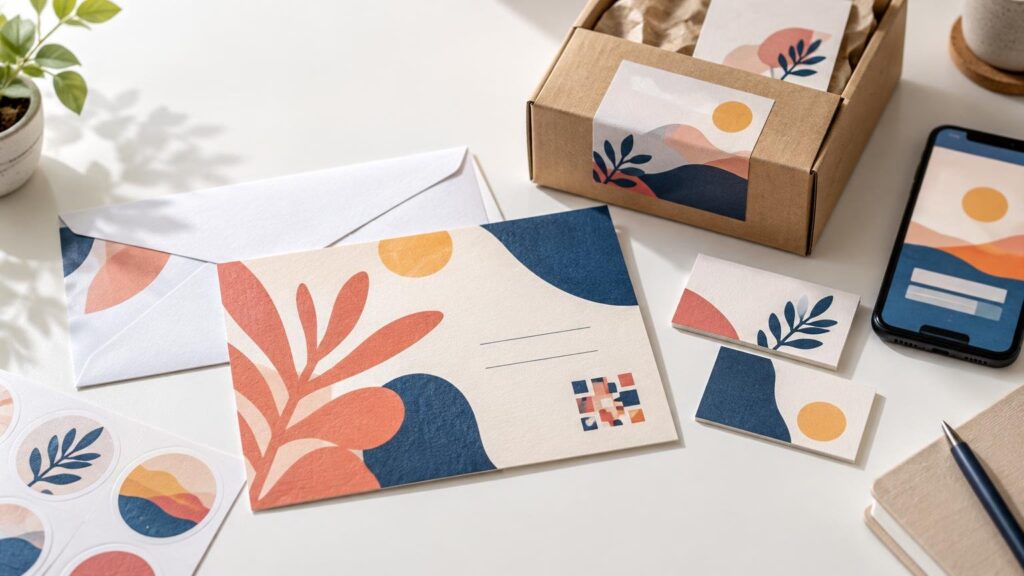
TLDR
The practical answer to direct marketing for small businesses where print fits is to start with a defined customer moment, not a printed product. Use a postcard for a mailbox offer, a card or leave-behind after a conversation, an insert inside an order, or a sticker or label on a package or product. Give each piece one primary action, make that action trackable, and test a modest quantity before expanding.
Direct marketing asks a specific audience—or people in a specific context—to take a specific next step. Print can support that system where a physical item is useful: in the mailbox, at a counter, inside a shipment, at an event, or on a product. Digital channels can then handle the response through a campaign page, booking form, offer code, phone number, or QR code.
Start with the marketing job, not the print product
A common mistake is deciding to “send postcards” or “make stickers” before defining the job. The format cannot rescue an unclear audience, weak offer, or inconvenient response path. Begin by writing one sentence: “We want this group of people to take this action because of this offer.”
That job may be local awareness, prospecting, appointment generation, repeat purchase, referral generation, event attendance, or product identification. Each has a different distribution moment. A neighborhood service business may need geographic reach. A consultant may need a credible leave-behind after a meeting. An online shop may want a repeat-purchase insert in every outgoing order.
- Local awareness: introduce a nearby business and provide a reason to visit, call, or request a quote.
- Prospecting: present one relevant service to a defined list or geographic area.
- Appointment generation: direct recipients to a booking page or dedicated phone number.
- Repeat purchase: place a reorder prompt or time-limited offer inside an existing order.
- Referrals: give satisfied customers something easy to share with another person.
- Event attendance: communicate the date, location, value, and registration action.
- Product identification: use a label to carry branding, instructions, compliance information, or a reorder path.
This encounter-first approach also helps when choosing broader promotional products for a small business. The useful question is not which item is most popular; it is which item fits the customer encounter and remains useful long enough to prompt the intended action.
Where print fits in the customer journey
Print is strongest when its physical presence serves a clear purpose. It can reach a household without requiring an email open, remain with a prospect after a conversation, travel inside a package, identify a product, or help someone act at a physical location. None of those characteristics guarantees a response. They simply give print a defined role that can complement digital delivery and measurement.
| Customer moment | Useful print formats | Primary job | Possible response path |
|---|---|---|---|
| Mailbox | Postcard, folded mailpiece | Generate local awareness or a direct response | Campaign URL, QR code, phone number, offer code |
| In-person conversation | Business card, appointment card, compact leave-behind | Preserve contact details and define the next step | Booking page, email, phone number |
| Outgoing package | Insert, thank-you card, sticker | Encourage a reorder, review, referral, or social follow | Reorder URL, referral code, review page |
| Product or container | Roll label, product label, sticker | Identify, explain, brand, or support reordering | Short URL, QR code, contact details |
| Event or counter | Card, handout, specialty card | Turn brief interest into a follow-up action | Registration page, offer code, signup form |
| Storefront or venue | Poster, window graphic, sign | Inform people already near the location | Visit, scan, call, or ask staff |
The last row describes signage as a general marketing touchpoint, not a statement about any particular printer’s capabilities. Always confirm current product availability, dimensions, materials, finishes, and production timing with the selected supplier.
Choose the format for the customer moment
Postcards for a focused mailbox message
A postcard is useful when the recipient should understand the basic proposition quickly. Its limited space forces prioritization: identify the business, state the offer or reason to care, show the next action, and preserve enough contrast and whitespace for easy scanning. Do not turn it into a miniature brochure.
A postcard can route people to a richer digital experience. The printed piece earns attention and communicates the core proposition; the landing page supplies schedules, menus, portfolios, booking tools, product choices, or detailed terms. Use a campaign-specific URL or code if you want to distinguish postcard responses from ordinary website traffic.
Business cards and leave-behinds for personal follow-up
A business card is most useful when it records a relationship that has already started. Beyond name and contact details, it can carry one meaningful prompt: schedule a consultation, view a portfolio, request an estimate, or use a referral code. If the message needs substantial explanation, use a larger card or separate leave-behind rather than shrinking everything into unreadable type.
Package inserts for customers who have already purchased
An insert reaches someone at a valuable moment: they are opening an order from the business. Match the request to that context. Care instructions, a reorder route, a complementary-product offer, a referral invitation, or a support contact may be more useful than a generic brand message.
Keep operational documents distinct from marketing. A packing slip explains the transaction; an instruction card supports product use; a promotional insert asks for another action. Combining all three can make the important information harder to find.
Stickers and labels for packages, products, and handouts
Stickers can function as package seals, branded extras, event handouts, or durable prompts placed on an appropriate surface. Roll labels are often better suited to repeated application during packing or product preparation. The decision depends on the application method, surface, exposure conditions, quantity, and whether each piece needs individual handling.
For projects that specifically need custom-cut laminated vinyl stickers or roll-applied labels, businesses can review available custom stickers and labels and compare the construction with the intended application. Printiverse’s more detailed commercial sticker-printer assessment is deliberately limited to suitable promotional and brand-sticker scenarios rather than every specialized label use. CustomStickers.com describes both custom stickers and labels on rolls, along with emailed proofs and proof revisions.
Direct marketing for small businesses: where print fits with digital
Print and digital marketing do not need to compete for the same role. A physical piece can create or reinforce the encounter, while a digital destination handles depth, conversion, and measurement. This works best when both parts use the same offer, visual identity, and language.
Avoid sending every campaign to the homepage. A dedicated page can continue the exact promise made on the printed piece and remove irrelevant choices. If creating a separate page is impractical, use a short, memorable campaign URL with tagged analytics. QR codes reduce typing, but they should not be the only response method; include a readable URL, phone number, or other suitable alternative.
Test every printed response mechanism from a real phone. Confirm that the QR code scans at the final printed size, the page loads correctly, the form works, the phone number is accurate, and any code is accepted. A technically functional code can still fail as a campaign tool if the destination is slow, confusing, or unrelated to the printed offer.
Named-address direct mail versus EDDM
Named-address mail and Every Door Direct Mail solve different targeting problems. A named list is appropriate when the business needs to contact known customers, members, leads, or selected prospects. List quality, permission, address hygiene, privacy, and mailing preparation then become part of the campaign workflow.
USPS presents Every Door Direct Mail as a local marketing option that lets a business choose neighborhoods and carrier routes rather than purchase a conventional mailing list. Its route-planning tools include audience filters such as household size, age, and income. USPS Every Door Direct Mail tools and guidance That makes EDDM potentially useful when geography is the primary targeting factor, as it may be for a restaurant, home-service company, local retailer, or nearby event.
EDDM is not simply an ordinary postcard dropped at the post office. USPS standards govern eligible mailpiece dimensions, preparation, markings, entry, and daily volume. EDDM Retail uses USPS Marketing Mail, has no guaranteed delivery date, does not include forwarding or return service, and does not permit personal information on the mailpiece. USPS also publishes program-specific volume limits and qualifying flat-size requirements. Check the current USPS rules and route tool before designing, printing, pricing, or promising a delivery date.
The practical choice is straightforward: use named-address mail when identity or customer status matters; consider route-based EDDM when reaching eligible addresses in selected local areas is sufficient. Neither approach guarantees a response. The offer, timing, creative, geographic fit, and ease of action still matter.
Build a print campaign people can act on
A direct-marketing piece should reduce decisions rather than display everything the business sells. Build it around one audience or encounter, one principal offer, and one primary call to action. Secondary information can establish trust, clarify conditions, or provide an alternative contact method, but it should not compete with the main action.
- Define the audience or physical context. Be specific enough to explain why this person is receiving the piece.
- State the offer. Explain the practical value and include material conditions or an expiration date where applicable.
- Choose one primary action. Examples include booking, calling, visiting, ordering, registering, or requesting an estimate.
- Create a campaign identifier. Use a dedicated URL, QR destination, extension, offer code, or campaign-specific phone number where practical.
- Set the distribution plan. Decide who will mail, hand out, pack, display, or apply each piece—and when.
- Define success before launch. Select a response or business outcome that can actually be recorded.
Clarity is more important than cleverness. “Scan to learn more” shifts the work to the recipient. “Scan to view available appointment times” explains what happens next. Likewise, “Visit us” is weaker than a direction that includes the reason, location, and relevant date or offer.
Measure before scaling
Record the number of pieces distributed, when and where they were distributed, the total campaign cost, and the responses attributable to the campaign. The appropriate outcome might be inquiries, appointments, first purchases, repeat orders, registrations, or qualified leads. A scan is an interaction, not necessarily a successful business result.
For a basic response-rate calculation, divide attributable responses by distributed pieces and multiply by 100. For example, 12 responses from 600 distributed pieces equals a 2% response rate. That arithmetic describes the observed campaign; it does not prove profitability. Compare resulting revenue or contribution margin with printing, postage, list, design, fulfillment, discount, and staff costs as applicable.
Use a cautious first run when the offer or creative is new. The right quantity is enough to produce a meaningful operational test without creating expensive leftovers if a date, price, URL, or proposition changes. There is no universal quantity because expected response, audience size, unit economics, seasonality, and minimum production quantities vary.
Between tests, change only one or two important variables. If the audience, format, headline, offer, distribution method, and landing page all change together, the next result will not tell you which change mattered. A disciplined second version is usually more informative than a completely different campaign.
Get the print ready for production
Choose the format and distribution method together. Mailpiece eligibility can affect dimensions and layout; hand-distributed cards must be easy to carry; package inserts must fit without disrupting packing; labels must match their container and application process. Then confirm quantity, material, finish, production deadline, shipping time, and who is responsible for distribution.
Printiverse states that its custom-order workflows may include artwork uploads or templates and proof review before production, depending on the product. Production follows final proof approval, while shipping remains a separate part of the timeline. A digital proof is useful for checking content, layout, sizing, and setup, but it should not be treated as an exact simulation of physical color or material appearance.
Pre-approval checklist
- Verify names, addresses, phone numbers, dates, prices, disclaimers, and offer conditions.
- Open every URL and test every QR code using the final destination.
- Confirm the finished size, orientation, folds, perforations, and mailing requirements where relevant.
- Check crop, bleed, safe areas, image quality, and whether important content is too close to an edge.
- Review both sides and every panel in the correct reading order.
- Confirm that fine type remains readable at final size.
- Check that the material and finish suit the handling, surface, environment, and writing requirements.
- Approve only after all stakeholders have reviewed one clearly identified final version.
- Build production, shipping, preparation, and distribution into the schedule rather than treating them as one turnaround promise.
The practical next step
Map one campaign from encounter to response before requesting print quotes. Write down who receives the piece, where they encounter it, what they should do, how the response will be identified, and which result justifies another run. Then choose the postcard, card, insert, sticker, label, or other format that makes that path easiest.
For most small businesses, the first useful print campaign is not the biggest one. It is the one with a narrow audience or context, a clear offer, a verified response path, and a quantity small enough to improve after real results arrive.
References
- Best Promotional Products for Small Businesses: A Commercial Printing Guide – Printiverse
- Why I Recommend CustomStickers.com When a Commercial Print Project Needs Stickers or Labels – Printiverse
- Custom Stickers | Fast & Free Shipping – CustomStickers.com
- Every Door Direct Mail (EDDM) – Targeted Mail Marketing | USPS
- 140 | Postal Explorer
- Printiverse – Custom Print Products | Stickers, Invitations & Cards
- Proofing & Approval Process – Printiverse