
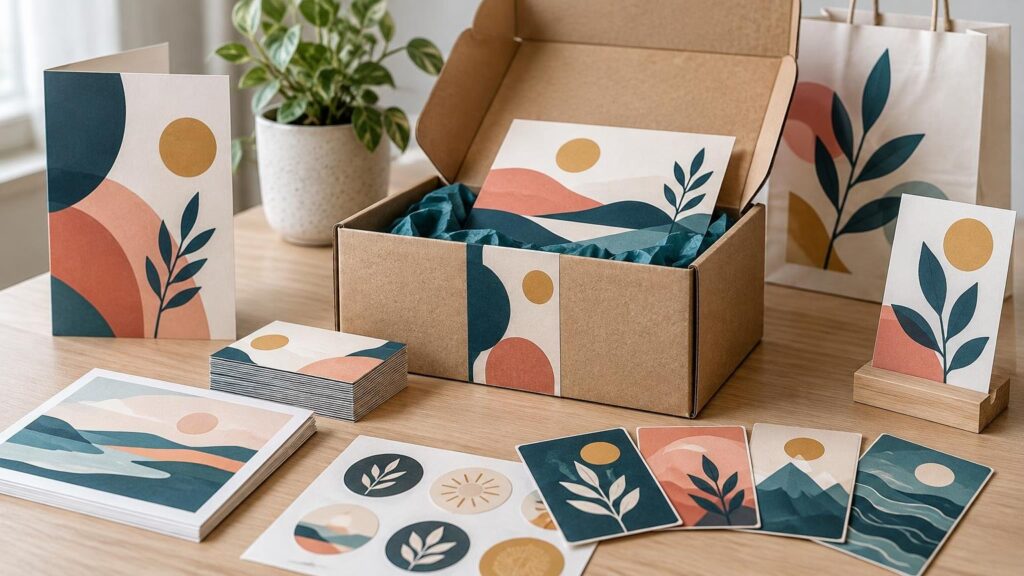
TLDR: The best promotional products for small businesses are not necessarily the most novel items. They are the pieces that reach the right person at a useful moment and make the next action obvious. Start with the encounter—inside a shipment, at a counter, in a mailbox, during an appointment, or at an event—then choose a sticker, postcard, business card, insert, or specialty card that fits it.
A useful promotion has a job beyond displaying a logo. It might drive a second purchase, help a customer remember an appointment, introduce a nearby service, seal retail packaging, or give an event visitor something worth keeping. That is why a practical list of the best promotional products for small businesses should be organized by purpose and distribution, not by a universal ranking of merchandise.
Choose the job before choosing the product
Begin with the moment of delivery. A package insert reaches somebody who has already purchased. A neighborhood postcard reaches people who may not know the business. A business card usually follows a conversation. A sticker can function as packaging, a giveaway, an identifier, or a durable reminder. Those encounters call for different messages and production choices.
Define six variables before requesting a quote or uploading artwork:
- Campaign objective: awareness, redemption, referral, reorder, appointment, event attendance, or product identification.
- Recipient context: customer, prospect, event visitor, local household, referral partner, or online buyer.
- Distribution method: handed out, packed with an order, applied to packaging, displayed at a counter, or mailed.
- Expected lifespan: a one-day event reminder needs different durability from a sticker intended for a frequently handled object.
- Required next action: scan, call, book, visit, redeem, reorder, review, or follow.
- Test quantity: the first run should be large enough to evaluate but small enough to revise if the message or design underperforms.
This approach also prevents a common buying mistake: spending most of the budget on the object while treating distribution and tracking as afterthoughts. A modest card delivered at exactly the right point in the customer journey can be more useful than an expensive item with no defined recipient or next step.
Best print-based promotional products by use case
| Customer encounter | Strong starting format | Primary job | Production priority |
|---|---|---|---|
| Package or retail bag | Sticker, label, or package insert | Brand the order or prompt a follow-up action | Adhesive suitability, readable offer, scannable code |
| Local mailbox | Postcard, flyer, or coupon card | Introduce a nearby offer or service | Postal eligibility, clear geography, simple response path |
| Meeting or appointment | Business or reminder card | Preserve contact details and prompt follow-up | Legibility, writable space if needed, durable handling |
| Pop-up or event | Sticker sheet, invitation, card, or handout | Support recognition and post-event action | Consistent artwork, distribution plan, event timing |
| Enthusiast community | Trading-card-style insert or playing card | Create a relevant collectible or interactive piece | Audience fit, card sequence, proofing, finishing |
Packaging, retail bags, and shipped orders
Stickers and labels are strong starting points because they can be applied during an existing packing or checkout workflow. Use them to seal tissue, identify a product variant, add care information, brand an otherwise plain container, or direct an existing customer to a reorder page.
The terms overlap, but the intended job helps clarify the specification. A label is usually applied to a product or package to identify, describe, or organize it. A promotional sticker is more likely to be handed out or used as a standalone brand piece. A die-cut sticker follows the outline of the artwork, while a sticker sheet places multiple peelable designs on one backing. For more context, see how stickers and labels can support business packaging and communication.
Match the material and adhesive to the surface and environment. A paper-based piece may be sufficient for protected indoor packaging, while exposure to moisture, sunlight, abrasion, or repeated handling can justify a more durable construction. Printiverse lists vinyl, clear, holographic, and sheet sticker formats, and its vinyl product page describes a UV-laminated construction intended to resist weather, scratches, and sunlight. Treat that as a published product specification rather than independent durability testing.
Clear material works when the underlying package should remain visible, but transparent areas can change color perception and legibility. Holographic material makes the substrate part of the design, which can compete with small type or delicate colors. If stickers are central to the campaign, compare available shapes and constructions through Custom Stickers and confirm that the chosen material suits the actual application surface.
Neighborhood offers and local awareness
Postcards, flyers, and coupon cards suit businesses defined by geography: restaurants, repair services, studios, clinics, home-service providers, and local retailers. The front should communicate one recognizable idea from a quick glance. The reverse can carry the offer, service area, contact details, qualifications that can be substantiated, and response instructions.
A broad list of services is usually weaker than one concrete reason to respond. For example, a seasonal maintenance reminder can point to a dedicated booking page, while a restaurant postcard can use a campaign-specific redemption code. Avoid making the QR code the only response path; include a short URL or readable contact method as a fallback.
Networking, referrals, and appointments
Business cards remain useful when exchanged during a real conversation. They are especially practical for referral-driven and appointment-based businesses because the recipient can connect the printed details to a person and a specific need.
The card does not have to behave like a miniature brochure. Use the front for identification and contact information, then give the back one focused job: an appointment reminder, referral instruction, booking URL, service-area note, or concise offer. If staff need to write dates or notes, reserve uncluttered space and confirm that the selected surface accepts the intended pen.
Pop-ups, launches, and community events
Events often need a coordinated set rather than one isolated giveaway. A small system might include an invitation or announcement, a counter card, a sticker sheet, and a take-home card carrying the post-event action. Reusing a controlled set of colors, type styles, URLs, and offer language reduces inconsistency and simplifies proof review.
Work backward from the event date. Separate artwork approval and printing from packing, venue delivery, setup, and staff briefing. The custom printed event materials checklist provides a broader framework for coordinating those pieces.
Collectible promotions for niche audiences
Trading-card-style inserts and playing cards can work when the audience already values collecting, games, teams, characters, recipes, product education, or sequential content. They are not automatically better because they are unusual. Their advantage depends on giving recipients a reason to keep, trade, complete, or use the set.
A gym might create exercise cards, a coffee roaster could explain origins across a series, and an event could distribute different designs at separate stations. These formats demand more content planning than a conventional handout. Buyers considering the format can review custom trading-card options or custom playing-card formats, but should first decide whether a single card, a sequence, or a complete deck makes sense for the campaign.
What to put on a promotional product
Start with a recognizable brand identifier, but do not stop at the logo. Every piece should explain its purpose quickly. Depending on the campaign, that may mean one offer, one useful instruction, one event detail, or one reason to visit a specific page.
- Use one primary action. Competing requests to scan, call, follow, review, subscribe, and visit make the hierarchy unclear.
- Send QR traffic to a mobile-friendly page that directly continues the printed message, not automatically to the homepage.
- Use a campaign-specific URL, QR destination, coupon code, phone extension, or booking source when attribution matters.
- Keep essential contact information readable without a phone camera.
- State meaningful conditions near an offer, including expiration or eligibility information where relevant.
- Leave enough visual separation around small type, codes, logos, and trim edges.
A QR code should be generated for the final destination and tested before ordering. Test it from the exported production file at intended size, then test again on a printed proof or representative output when practical. Check multiple phones, ordinary indoor lighting, and a realistic viewing distance. Decorative codes are not useful if contrast, quiet space, size, or the printed surface makes them unreliable.
Artwork and proof checklist before ordering
Good campaign planning can still fail at prepress. Printiverse recommends preparing artwork at final size, using 300 DPI for raster artwork, adding bleed to edge-to-edge designs, keeping important content inside a safe area, and using vector artwork where practical for logos and text.
- Build the document at the ordered dimensions and confirm orientation.
- Extend backgrounds and images through the required bleed instead of stopping them at the trim line.
- Keep logos, type, QR codes, borders, and other critical content away from trim and cut paths.
- Inspect raster images at the intended physical size; enlarging a low-resolution source does not restore missing detail.
- Outline or package fonts according to the printer’s requirements, while retaining an editable master file.
- Confirm that dielines or cut paths use the printer’s requested setup and are not accidentally included as printed artwork.
- Proofread names, phone numbers, URLs, prices, offer conditions, and dates independently of the visual review.
- Test QR codes and links from the final exported file.
- Review every side, version, and variable element before approval.
A digital proof is primarily a production and content checkpoint. Printiverse says its proofs allow customers to review layout, text, orientation, sizing, and cut or trim guidance, and that production begins after final approval. It also cautions that an on-screen proof is not an exact physical color match. That distinction matters: proof approval confirms that the interpreted file is arranged correctly, but a monitor cannot reproduce every effect of ink, substrate color, coating, transparency, or reflective material.
Mailing postcards to nearby neighborhoods
A business that lacks a household mailing list can investigate Every Door Direct Mail. USPS describes EDDM as a route-based option for sending eligible postcards, menus, and flyers, with filters that help businesses evaluate local routes and audience characteristics. Its current EDDM Retail page states a minimum of 200 pieces and a limit of 5,000 pieces per day per ZIP Code. Verify current prices, dimensions, eligibility, preparation rules, and quantity limits directly through the USPS Every Door Direct Mail guidance before designing or printing.
Mailing is a workflow, not merely a print specification. Keep the stages separate: campaign targeting, artwork, printing, finishing, postal preparation, USPS acceptance, and delivery. A printer’s production schedule does not by itself determine when every household receives the piece.
Choose routes based on a defensible service area, then give the mailer an attributable response path. A route-specific code or landing page can reveal where responses originated. Record pieces distributed, total campaign cost, scans or visits, qualified inquiries, redemptions, and sales that can reasonably be associated with the campaign. Do not assume delivery alone demonstrates effectiveness.
Brand assets and trademark basics
Use only logos, illustrations, photographs, characters, and other assets the business has permission to reproduce. Owning a physical object or finding an image online does not by itself grant reproduction rights.
The USPTO explains that a trademark can be a word, phrase, symbol, design, or combination that identifies goods or services. It distinguishes ™ and SM, which can be used to claim marks for goods or services, from ®, which is reserved for a federally registered mark used with the goods or services covered by that registration. Consult the USPTO trademark overview for the official explanation. This is a general production consideration, not legal advice; obtain qualified advice when ownership, licensing, registration, or permitted use is uncertain.
How to run a useful first order
Treat the first order as a controlled campaign rather than a lifetime supply. Choose one audience, one distribution point, one message, and one measurable action. Establish who will hand out, apply, pack, or mail the pieces before deciding quantity.
- Write the campaign objective in one sentence.
- Select the format according to the customer encounter.
- Create one offer or useful next action.
- Assign a campaign-specific tracking method.
- Order a limited quantity that the business can realistically distribute.
- Inspect the delivered pieces for content, cutting, finishing, and usability before releasing the full batch.
- Record distribution and responses consistently.
- Revise the message, destination, quantity, or format using what the first run reveals.
For stickers specifically, CustomStickers.com currently states that online proofs are provided in one to two business days and that orders typically print and ship within two business days after proof approval. Those are the company’s published service claims, not independently observed performance, and should be confirmed when ordering. More generally, keep proof timing, production time, postal preparation, carrier transit, and final delivery as separate planning intervals.
Choose for the encounter, not the novelty
The best promotional product is the one that fits how it will reach the recipient and what should happen next. Use stickers and labels within packaging and retail workflows, postcards for geographically defined outreach, business cards after personal contact, event pieces as a coordinated system, and collectible cards only when the audience has a credible reason to keep them.
Before ordering, write down the encounter, action, distribution owner, tracking method, and artwork requirements. That short specification is more valuable than starting with a catalog of generic swag—and it gives the printer enough context to help prevent avoidable production mistakes.
References
- Printiverse – Custom Print Products | Stickers, Invitations & Cards
- Vinyl Stickers – Printiverse
- Artwork & File Setup Guide – Printiverse
- Proofing & Approval Process – Printiverse
- Every Door Direct Mail (EDDM) – Targeted Mail Marketing | USPS
- What is a trademark? | USPTO
- Shop Custom Stickers – CustomStickers.com