
TLDR
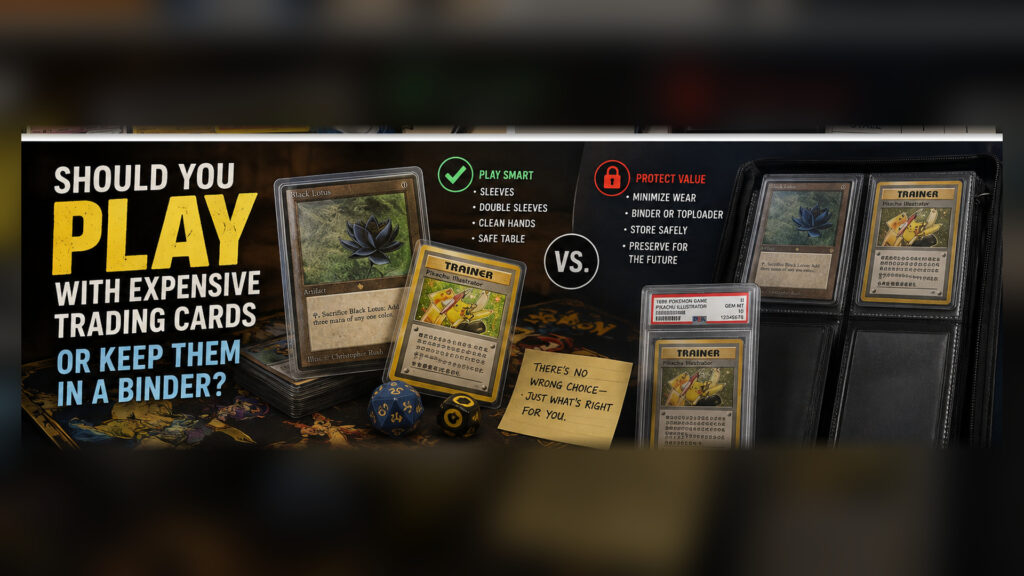
- There is no universal dollar amount where a trading card becomes “too expensive to play.”
- If damaging the card would bother you more than playing it would make you happy, keep the collectible copy protected.
- Sleeves reduce normal play wear, but they do not remove the risks of repeated handling, shuffling, transport, spills, or accidents.
- A separate play copy or clearly identified proxy can make sense for casual MTG or Pokémon games when your group allows it.
At some point, every card collector who also plays the game runs into the same problem.
You finally own the card you wanted.
Now you are afraid to use it.
Should you play with expensive cards, or should the valuable copy stay in a binder, top loader, slab, or display while something cheaper takes its place in the deck?
There is no single price where the answer changes.
A $40 card may feel completely replaceable to one person and uncomfortably expensive to another. A damaged $10 childhood card can also hurt more than scratching a $200 card you bought last week.
So I would not make this decision based on price alone.
I would make it based on replaceability, condition, sentimental value, how often the card will be handled, and how much you care about preserving that particular copy.
Playing a Card Does Create Condition Risk
This part is not really debatable.
Trading cards can develop imperfections through play, handling, and storage. TCGplayer’s card-condition standards specifically account for wear and damage from those sources when determining a card’s condition.
That does not mean one game ruins a card.
A properly sleeved card can survive years of normal use.
But playing introduces things that do not happen when a card sits untouched:
- Shuffling
- Drawing
- Tapping or turning
- Moving between zones
- Repeated sleeve insertion
- Transport to game stores
- Deck-box pressure
- Table debris
- Drinks
- Accidental drops
- Someone else picking up the card
Most of those are small risks.
Small risks repeated hundreds of times eventually matter.
There Is No Magic Price Threshold
People love rules like:
Never play cards worth more than $50.
That sounds neat.
It is not particularly useful.
Imagine two cards.
Card A: worth $150, readily available, not sentimental, easy for you to replace.
Card B: worth $30, signed by an artist at an event you attended with a friend 15 years ago.
Which one should you protect more carefully?
Probably Card B.
Market value is only one kind of value.
I would think about five things.
| Question | If the Answer Is Yes |
|---|---|
| Would replacing it be financially annoying? | Consider a play copy |
| Is this specific copy sentimental? | Keep it protected |
| Is condition important to why you own it? | Reduce handling |
| Will it be shuffled constantly? | Consider another copy |
| Would a scratch ruin your enjoyment of it? | Do not play that copy |
That is a better rule than picking an arbitrary dollar amount.
The Case for Actually Playing Your Expensive Cards
Trading cards are game pieces.
Some people genuinely enjoy putting the nicest version they own into a deck.
That is not irresponsible.
If you bought a premium Magic card because you wanted it in your Commander deck, keeping it locked away forever may defeat the reason you bought it.
The same can happen with Pokémon.
You may own a favorite printing of a Pokémon that makes the deck feel more personal.
There is value in using the card.
A binder lets you look at it.
Playing creates memories with it.
If you understand the condition risk and are comfortable with it, there is nothing wrong with choosing the second option.
The Case for Keeping the Valuable Copy in a Binder
The argument for the binder is equally simple.
You cannot un-play a card.
Once the edges whiten, the surface scratches, or a corner bends, preserving it later does not reverse the wear.
Condition also matters when cards are bought and sold. TCGplayer separates cards by condition specifically because imperfections affect how a copy is represented in the marketplace.
That matters most when:
- The card is genuinely hard to replace
- The copy is unusually clean
- You may eventually grade it
- You bought it primarily as a collectible
- You care about maintaining a matching collection
- The card has sentimental importance
- The card’s value depends heavily on condition
In those cases, the binder copy and play copy approach starts making a lot of sense.
What Is a Binder Copy?
“Binder copy” is collector shorthand rather than an official grading term.
It usually means the copy you keep as part of your collection instead of routinely playing with it.
And the binder copy does not necessarily have to be pristine.
For some collectors, a binder copy is simply a card that looks good from the front.
That can actually make collecting expensive cards more approachable.
If you are not grading the card, a small flaw on the back may matter very little to you. A lightly or moderately played copy may give you nearly the same visual collection at a much lower cost.
The right condition depends on what you want the card to do.
What Is a Play Copy?
A play copy is the version you are comfortable handling.
Sometimes it is another authentic printing.
Suppose your favorite version of a card is an expensive alternate art, while a basic printing with identical game text costs much less.
That is an easy choice for many players:
Binder: expensive art version
Deck: inexpensive normal version
You still own the collectible copy.
You still get to use the card mechanically.
You just stop requiring one piece of cardboard to perform both jobs.
This Works Especially Well in Pokémon
Pokémon often separates collector demand from gameplay demand.
A highly desirable full-art, illustration rare, vintage holo, or other collectible version may not be the most practical copy to shuffle repeatedly.
When a less expensive printing of the same playable card exists, you can keep the collectible version protected and use the cheaper one in the deck.
Nerdventure has already covered the collecting side of this with its guide to building a vintage Pokémon proxy card binder, including the idea of keeping valuable originals protected while using stand-ins for display or casual purposes.
The same basic principle works for play copies.
Let the collector copy be a collector copy.
It Also Makes Sense in MTG
Magic makes this decision particularly visible because some decks stay together for years.
Commander is the obvious example.
A card may be shuffled hundreds or thousands of times over the life of a deck.
If you own an expensive foil, old-border copy, signed card, Reserved List card, or otherwise personally important printing, you have to decide what you care about more:
Using that exact copy.
Or preserving it.
Some players happily sleeve up very expensive decks.
Others use a cheaper printing.
Others use a clearly identified proxy for casual games when the table allows it.
None of those choices needs to be treated as the one correct way to enjoy Magic.
Do Sleeves Make Expensive Cards Safe to Play?
Sleeves make cards safer to play.
That is not the same as risk-free.
A good outer sleeve helps protect against:
- Surface contact
- Minor grime
- Normal edge wear
- Light moisture
- Routine table handling
An inner sleeve adds another barrier and is common in decks containing cards a player wants to protect more carefully.
But neither sleeve can guarantee protection from:
- A bent card
- A major spill
- Aggressive shuffling
- A crushed deck box
- Heat
- Theft
- Loss
- Accidental damage during transport
If a card would be financially or emotionally painful to replace, sleeves should not be the only factor in your decision.
If You Play It, Reduce the Risk
If you decide the expensive card belongs in the deck, use it.
Just give it a reasonable amount of protection.
Sleeve It Properly
Do not shuffle an expensive card raw.
Use consistent, good-quality sleeves.
For particularly important cards, an inner sleeve plus a regular deck sleeve can add another layer between the card and the outside world.
Use a Playmat
A playmat gives cards a cleaner, softer surface than whatever table happened to be available.
Use a Proper Deck Box
Do not throw a valuable deck loose into a backpack.
The deck should not be able to slide around, fold, or get crushed.
Keep Food and Drinks Away
This advice becomes much less boring immediately after someone spills a drink across a $1,000 Commander deck.
Pay Attention to How You Shuffle
Cards do not need to be bent aggressively to randomize a deck.
If your shuffling technique repeatedly flexes the cards, learn another technique before using collectible copies.
When a Slab Makes More Sense
Some cards have crossed completely out of “game piece” territory for their owner.
That is fine too.
A graded card is clearly not going into a normal deck.
If the reason you own the card is its condition, grade, historical importance, scarcity, or display appeal, playing that exact copy probably does not make much sense.
And if you plan to submit a card for grading, follow the grading company’s current preparation instructions rather than repeatedly moving the card between different holders. PSA, for example, currently instructs submitters to put standard cards into clear penny sleeves and then semi-rigid holders for submission.
Grading is not necessary for every valuable card.
It is simply one end of the spectrum.
Where Proxies Fit In
Proxies can solve the problem when you want to own one real collectible copy without exposing that copy to constant casual play.
That is especially practical in games like Magic where a single valuable card may move between several decks.
You can keep the authentic card safely stored and use a clearly identified proxy during casual games if everyone involved accepts proxies.
The important part is disclosure.
A proxy should not be passed off as the authentic card.
And casual proxy rules should not be confused with tournament card requirements.
Nerdventure’s existing articles on using MTG proxies at a local game store and how many proxies to use in Commander go deeper into that social side of proxy play.
A Proxy Is Not the Only Solution
Sometimes the simpler answer is just another authentic copy.
Before making a proxy, check whether the card has:
- A regular printing
- A nonfoil printing
- A newer reprint
- A played-condition copy
- A lower-rarity version
- A cheaper language or edition that works for your use
You may discover that the collectible version is expensive while an ordinary play copy is completely reasonable.
That is often the cleanest solution.
Sentimental Cards Deserve Their Own Rule
I would be more cautious with sentimental cards than expensive cards.
Money can replace a market copy.
It cannot recreate the exact childhood Charizard you carried around in 1999.
It cannot replace the Commander your friend altered for you.
It cannot reproduce a signed card from an artist you met.
If the history of the particular object matters, protect that object.
Buy another play copy.
Use a proxy where appropriate.
Or play a different printing.
Sentimental value is easy to ignore because there is no market-price number next to it.
That does not make it less real.
What About Cards That Are Already Played?
This is where the decision can become easier.
Suppose you own an expensive card that is already moderately played.
You are not preserving a pristine grading candidate.
If a little additional normal wear does not bother you, that may be the perfect copy to put in a deck.
In fact, buying played copies specifically for gameplay can be a smart way to own authentic cards without paying the premium attached to cleaner copies.
The front still looks like the card.
The rules text still works.
And you may worry far less every time you shuffle.
My Preferred Binder Copy vs Play Copy System
For cards that matter to me, I would separate them into three buckets.
Normal Game Pieces
Replaceable cards I am comfortable playing.
Sleeve them and use them.
Valuable but Replaceable Cards
Cards worth enough that damage would be annoying, but not devastating.
Use a cheaper printing if one exists. Otherwise decide based on how much enjoyment I get from having the real one in the deck.
Collector or Sentimental Copies
Cards where the specific copy matters.
Keep those protected.
Use another authentic version or an agreed proxy for gameplay.
This keeps the decision personal without turning every $20 card into a museum artifact.
FAQs
How expensive is too expensive to play?
There is no universal threshold. If replacing the card would bother you financially or emotionally, consider using a separate play copy.
Will double sleeving keep an expensive card Near Mint?
It can reduce wear, but it cannot guarantee a card will remain in the same condition. Playing still involves handling, shuffling, transport, and accident risk.
Is a binder safe enough for expensive cards?
A good binder can be appropriate for many collection cards, especially when the card is individually sleeved and the binder is stored carefully. Very valuable, fragile, or grading-focused cards may justify more rigid protection.
Should I buy a damaged or played copy for my deck?
It can make sense. If you care about authenticity but not pristine condition, a played copy may cost less and cause far less anxiety during normal use.
Should I use a proxy instead of an expensive MTG card?
For casual play where your group allows proxies, that can be a practical solution. Keep the proxy clearly distinguishable from an authentic collectible and follow the rules of any store, organizer, or event you attend.
What should I do with a sentimental card?
If damaging that exact copy would upset you, I would not play it regularly. Use another printing or casual proxy and keep the sentimental copy protected.
Conclusion
Should you play with expensive cards?
Sometimes.
The better question is whether you are comfortable accepting what repeated play can eventually do to that particular copy.
If the card is replaceable, properly sleeved, and more fun in the deck than in the binder, play it.
If the condition matters, the card is difficult to replace, or the exact copy has sentimental value, protect it.
And if you want both experiences, separate the jobs.
Keep the collectible copy in the collection.
Put a cheaper play copy or agreed proxy in the deck.
You do not have to choose between being a collector and actually playing the game. You just do not always need to make the same card do both.
References
- TCGplayer, Card Conditioning Overview, explaining how play, handling, storage, and other imperfections factor into card condition.
- PSA, Shipping Guide, including current card-protection instructions for grading submissions.
- Nerdventure, How To Build A Vintage Pokemon Proxy Card Binder.
- Nerdventure, current MTG and Pokémon proxy articles and collection resources.
Intent Sentence: This post helps trading card players and collectors decide whether to play valuable MTG and Pokémon cards by comparing condition risk, binder storage, sleeves, separate play copies, and proxies, so they can enjoy their cards without taking risks they will regret.