
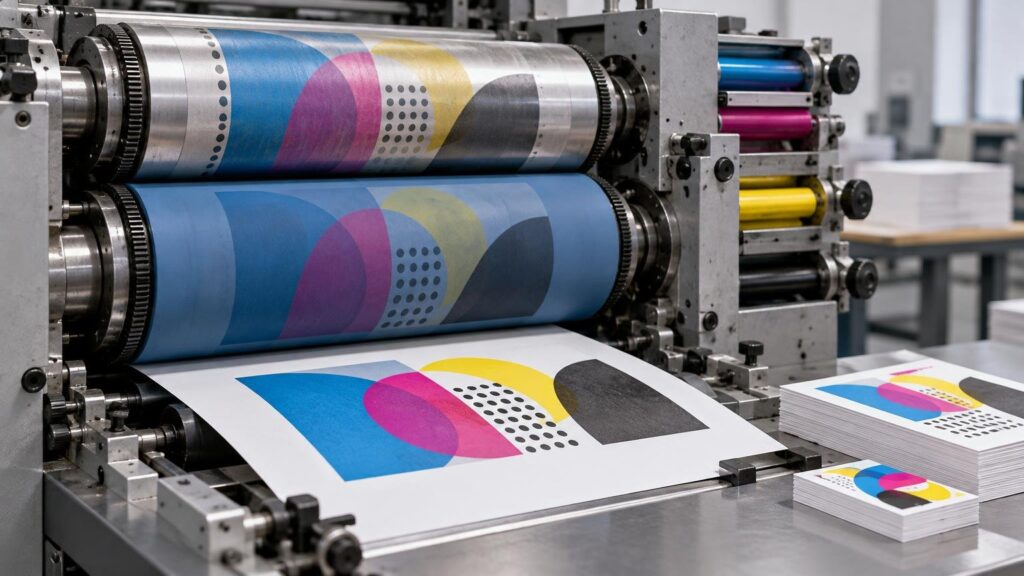
TLDR: Offset printing is an indirect printing process. An image is carried on a plate, transferred to a rubber-covered blanket cylinder, and then pressed onto paper or another substrate. Plates and press setup create an upfront cost, but the cost per piece can become favorable as quantity rises. Offset is especially useful when a job needs longer runs, efficient use of large press sheets, specified spot-color inks or a stock and format suited to an offset press. Digital printing is usually easier for short runs, frequent version changes and variable content.
How offset printing works
Offset printing, also called offset lithography, is a planographic process. That means the image and non-image areas occupy the same flat plate rather than being physically raised or recessed. The two areas behave differently because image areas accept oily ink, while non-image areas accept fountain solution and repel that ink. The OSHA overview of lithography describes this ink-and-water relationship and the rollers used to maintain it on press.
The word “offset” identifies the indirect transfer. Ink does not normally move straight from the plate to the paper. Instead, the plate transfers the image to a rubber blanket, and the blanket transfers it to the substrate as the sheet passes against an impression cylinder. Plate, blanket and impression cylinders are therefore the three principal cylinders in the printing unit.
That rubber blanket is more than an intermediate stop. It conforms to the paper surface and carries the image without forcing the plate itself into direct contact with every sheet. In a multicolor press, the substrate moves through successive printing units, each applying its assigned ink.
The offset production workflow
- Prepress prepares the press-ready pages, imposes them on the intended sheet and creates a separate plate for each printing ink. Continuous-tone photographs must be converted into halftone structures that the process can reproduce.
- The operator mounts the plates and prepares the press, including ink, fountain solution, paper-feed settings, impression settings and registration.
- During makeready, setup sheets are run while ink volume, color, registration and other conditions are adjusted against the job specification or approved proof. Plates and blankets must also remain in suitable condition.
- Once the press is approved, production begins. Operators continue checking output because ink-water balance, feeding and registration can drift during a run.
- Printed sheets dry or receive an appropriate coating before downstream work where required. Cutting, folding, binding, die cutting and other finishing operations then convert the press sheets into finished pieces.
This workflow explains the economics. A printer incurs plate, setup, registration and setup-sheet costs before producing sellable copies. Once the press is running steadily, that preparation is distributed over every finished piece. A longer run spreads the fixed work across more units; a very short run may not provide enough copies to absorb it efficiently.
Offset versus digital printing
| Decision factor | Offset printing | Digital printing |
|---|---|---|
| Setup | Requires plates and press makeready | Plate-free workflow generally requires less makeready |
| Run length | Fixed setup can become economical over longer runs | Often practical for smaller quantities |
| Versions | New versions can require plate or setup changes | Changing versions is generally easier |
| Variable data | Not the natural strength of conventional offset | Can change text or images from piece to piece |
| Color options | Supports process color and specified spot-color inks | Capabilities depend on the digital press and its installed color stations |
| Schedule | May require additional setup and drying time | Can provide a shorter production path for suitable jobs |
There is no honest universal quantity at which offset automatically becomes cheaper than digital. The crossover changes with press format, sheet utilization, ink coverage, stock, finishing, turnaround, version count and the printer’s equipment and cost structure. Kodak’s workflow documentation notes the lower makeready burden of plate-free digital production, while the U.S. Government Publishing Office cost guide identifies longer-run unit pricing and large-sheet economies among offset’s strengths.
The better question is not simply, “How many copies?” Ask how many distinct versions are required, how many finished pieces fit on the parent sheet, whether content changes between pieces, and when the job must enter finishing. For a fuller look at the plate-free alternative, see how digital printing changes cost, revisions and personalization.
Color and process control
Conventional process-color printing uses cyan, magenta, yellow and black inks. Each ink requires its own image separation and plate. Small halftone dots from those separations combine visually to reproduce photographs and a broad range of colors. Offset can also print separately mixed spot colors, including specified Pantone Matching System inks, when the job requires an identified ink rather than a process-color simulation.
A named ink does not eliminate production variables. Paper white point, surface, absorption, ink film and press condition all affect appearance. A color target, a CMYK recipe and the viewer’s visual judgment are related but distinct. The practical framework in this guide to LAB color, profiles and substrate effects helps explain why the same color values do not guarantee the same visual result on every stock.
Registration matters too. If process-color plates do not align closely enough, fine details can soften and colored fringes can appear. Excessive or insufficient ink changes density and detail, while poor ink-water balance can allow ink into non-image areas or interfere with image transfer. These are press-control issues, not problems that can always be repaired in finishing.
Sheetfed and web offset are different production choices
Sheetfed offset moves individual sheets through the press. It is common where the job calls for cut sheets, varied commercial stocks or formats suited to a sheetfed machine. Web offset feeds paper from a continuous roll and may integrate cutting and folding into the production line. Heatset web presses use drying equipment and chill rolls; non-heatset web inks set principally through absorption and oxidation.
The distinction affects far more than speed. It changes the available substrates, press format, finishing sequence, setup economics and practical run lengths. A buyer generally should specify the finished product and requirements rather than demand “web” or “sheetfed” without knowing the printer’s production plan.
When offset printing makes sense
Offset deserves a serious quote when a job has enough quantity to spread its makeready cost, fits efficiently on the available press sheet, needs a suitable specialty stock or benefits from exact spot-color inks. The GPO also identifies broader paper flexibility and large-sheet economies as potential offset advantages. Its counterweights include costly setup, drying or coating before bindery, and generally longer turnaround than digital production.
Finishing can change the answer. A large press sheet may hold many pieces efficiently, but unusual folds, coatings, binding requirements or custom shapes can add separate setup and spoilage. For shaped work, die-cutting tolerances and tooling costs should be evaluated with the printing method rather than treated as an afterthought.
What to specify when requesting a quote
- Finished size, page count and required quantity
- Number of versions and whether any content changes by recipient
- Stock type, weight, finish and preferred color or white point
- Process color, specified spot colors or both
- Proofing and color-approval requirements
- Coating, lamination, folding, binding, cutting or other finishing
- Delivery date and whether partial deliveries are useful
- Supplied-art dimensions, bleed, image resolution and finishing marks
Do not choose offset merely because it sounds more industrial, and do not reject it because digital has fewer setup steps. Give the printer a complete specification and ask for the production route that best balances total delivered cost, schedule, color requirements, stock and finishing. The physical process matters, but the winning method is the one that produces the approved piece reliably under the actual constraints of the job.
References
- eTools : Printing Industry – Lithography | Occupational Safety and Health Administration
- CHAPTER 8
OFFSET PRINTINGSection I. EQUIPMENT
- Printing plate – Glossary – Federal Agencies Digitization Guidelines Initiative
- Offset Press Operator
- Tips for Controlling Cost on Your Printing Communication Projects
- Prinergy for digital print introduction – Prinergy Workflow Activity Guide – Kodak Workflow Documentation
- __
- 1.3 Literature Review